




“I would always participate in a lot of different activities. I played competitive hockey and I grew up doing musical theatre, I liked being involved.”
Ashley Clifford could be described as easygoing, lively and a bright student. Through her teenage years, she was known to excel in most things that she participated in.
It wasn’t until her first year of university that she started to feel like things were becoming a challenge.
“I began to feel like I had lost myself.”
Clifford says that during her teenage years she lacked a lot of free time outside of her extracurriculars.
When she began to meet people at University, she wanted to experience the freedom of not having such a thorough schedule.
“All of a sudden I had all these parties to go too and I was doing things I had never experienced,” recalls Clifford. “I kind of went a bit crazy in first year and I think I over did it.”
Clifford describes those first few months as the time she first noticed her mental health going down hill, but it wasn’t until her second year of school that she had met her breaking point; when a stable relationship began to crumble beneath her.
A blessing in disguise
“I used to be someone who always needed a boyfriend or partner in my life and I used to throw myself into that person.”
When Clifford’s stable relationship came to an end, she admits she ended up losing control. “He ended up contacting my parents to tell them he couldn’t be in my life anymore and that he believed I wasn’t doing very well,” she said.
Concerned about their daughter, Clifford’s parents drove from Leamington Ont. to Western University to check in.
“That was my big wake up call,” she explained. “That was the moment I thought, I should really get this addressed. I need to start seeing someone and talking to someone.”
According to the Canadian Mental Health Association, once depression is recognized in individuals, 80 percent of those affected are able to work towards regaining their personal normalcy.
“I felt like the school resources were there but unless you had a very specific situation, the resources were kind of like a one time use.”
Seeking resources
After a lack of success using school resources and beginning to feel her anxiety and depression take control of her every day life, Clifford decided to seek out information on medication.

UWO graduate, Ashley Clifford (Photo provided by / Ashley Clifford)
“It was difficult because my parents weren’t comfortable with the idea so I felt like I had to hide that from them.”
Clifford expands that her parents fear behind medication came from a place of love.
“I think seeing me in such a bad place, they were worried that I would use it as a band-aid and not work on myself and speak to someone about what I was going through,” she explained.
Noting that, at the end of the day, finding what works for you as a person and your unique situation is all you can do.
Although many schools have extensive mental health resources, quite often when students feel it is not enough, many do not know where to look otherwise. The CMHA offers many free resources for any one who feels they need them.
Feeling stigma
Clifford describes the lowest points of her depression as losing friendships, not being able to do simple tasks like getting out of bed, and feeling guilty for not being able to do better. Explaining the further strain it took on her education, relationships and well being.
“I think this is common for people who suffer from depression, but I remember my room being a mess. It was almost like a cave,” she explained. “I didn’t care about my surroundings… I had black out drapes, dim lighting and everything was just a disaster.”
The UWO grad reflects, noting that her surroundings were likely a huge cause of her feeling more anxious and down, but she felt like there was no coming out of it.
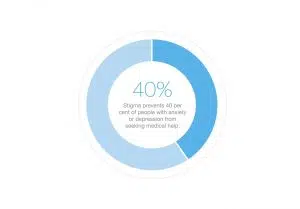
Addressing stigma infographic (Graphic provided by / CAMH) “Stigma prevents 40 percent of people with anxiety or depression from seeking medical help”
- Negative attitudes including a negative response can make people feel shamed about their lived experiences
- Stigma can change how people feel about themselves and the way others view them.
- Stigma can be felt far after a persons mental health problems have been healed
Coping Mechanisms
It’s been six years since the beginning of Ashley Clifford’s mental health journey. She says although she’s come a long way when it comes to how she now deals with her depression and anxiety, it will always be a learning experience.
“Over the years I’ve began to understand that although I’m not always in control of my anxiety, I’ve learned that knowing the symptoms and feelings I experience before having an attack can help me be in control.”
Clifford adds that using this method helps her stay centred and grounded which helps her focus on things that she can control in the moment. Mentioning that even something as small as petting an animal can really help bring you back to reality.

Former Humane Society employee, Ashley Clifford (Photo provided by / Ashley Clifford)
“When you’re trapped in your room and it’s a mess… whether you clean off your bedside table, get up to make a snack or open your drapes, they’re still small steps that make a difference,” Clifford expressed. “Some days you can’t even do those small steps and on those days you need to focus on something that is real, something that makes you feel good.”
Other coping mechanisms Clifford mentioned that helped her over the years include: getting fresh air, watching television or a movie that makes you happy, trying to create a routine, making some small goals to have something to look forward to or investing into yourself.
“I remember feeling like I wasn’t going to get through it and not knowing when it was going to end or when I would start to feel better,” she recalls. “But it will happen… and it may not be tomorrow, but it slowly starts to get better, in the mean time just try your best to take care of yourself.”
According to the CMHA, in any given year, 1 in every 5 Canadians will personally experience a mental health problem or mental illness.
Contact: CMHA National
Contact: CMHA Middlesex


