



People are often described as healthy or unhealthy, however; to understand health, you need to understand wellness.
Looking at overall health is going beyond the absence of disease or illness and looking at not only your physical well being but your mental, spiritual and social well being as well.
As the world began to face a global pandemic earlier this year, many people felt what was described as pandemic fatigue. Of those people, it is likely that some experienced a change in their health.
While this sensation was new to some, for those in the world of health care it is nothing out of the ordinary.

Mental Health worker & public educator, Michelle Phillips
It’s the cost of caring
Mental health worker and public educator for the Canadian Mental Health Association, Michelle Phillips, describes the cost of caring as compassion fatigue.
“We’re looking at the profound physical and emotional erosion that takes place when helpers are unable or feel unable to refuel or regenerate.”
Phillips expands, when helpers suffer compassion fatigue it can impact their ability to feel empathy or hope in their role, situation or even at home.
“When we talk about helpers, this can definitely be a professional setting but it also includes those who are acting as a caregiver to a family member or friend.”
Many times compassion fatigue is left untreated and has opportunity to expand to total burn out which can lead to feeling exhausted, pessimistic and defeated.
The mental health continuum
Phillips describes a scale that runs from one until ten. The top of the scale (being ten) is the image of your best life. You feel fulfilled with a full sense of purpose and the ability to accomplish your goals. On the other end of the scale (being one) is where mental health problems and chronic illnesses begin to appear.
The public educator continues to explain that where you as an individual find yourself on that scale is really dependant on your own perception of your current health and wellness. Where you tend to sit is where your baseline tends to be, describing the baseline as where you feel good and are able to contribute to daily activities.
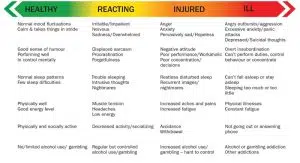
Photo by canada.ca
“We can definitely be pushed outside of that baseline depending on outside circumstances,” Phillips explains. “Chronic stress levels, problems with family and friends or an illness of some sort can all be contributors.’
But it’s our ability to bounce back to that baseline where we feel really good, stable and content that allows us to be so resilient to some of those outside circumstances that push us outside of that baseline.
The CMHA worker describes resiliency as long term strategies, saying, the more you go through in life, the more capable you are to bounce back when pushed from your baseline.
However, when you’re suffering from compassion fatigue… bouncing back is not always an attainable feeling. This inability to cope can often lead someone to feel heavy bouts of chronic stress, anxiety or even depression.
Strategy suggestions from a mental health worker
- Practice what you preach: it is hard to take care of others when you’re not giving yourself enough time and love
- Set boundaries: create a good line of communication with the people you are working with. Let them know what your expectations are of them and allow them to tell you what their expectations are of you.
- Mindful of your own personal time: Do you have a way to separate your time from work and your personal life? Michelle suggests turning off your work email after hours, listening to a positive podcast on the way home or getting changed and starting fresh at home.
- Know your role: People who work in the helping field can tend to take on a lot because they have so many brilliant skills and expertise. Helping is in their nature, but it is possible to take on too much. Allow yourself to redirect the help if it’s too much for you. Be self aware and honour your own safety.
24/7 Crisis and addiction support :
www.reachout247.ca 519-433-2023 / 1-866-933-2023


